HDLBits 系列(44)状态机补录

前言
今天补一个状态机的题目,也是这个系列的题目之一,但是由于之前对题目有点疑惑,今天得到博友反馈,让我明白了这个题目的意思,记录一下。
原题链接
原题复现
Consider a finite state machine that is used to control some type of motor. The FSM has inputs x and y, which come from the motor, and produces outputs f and g, which control the motor. There is also a clock input called clk and a reset input called resetn.
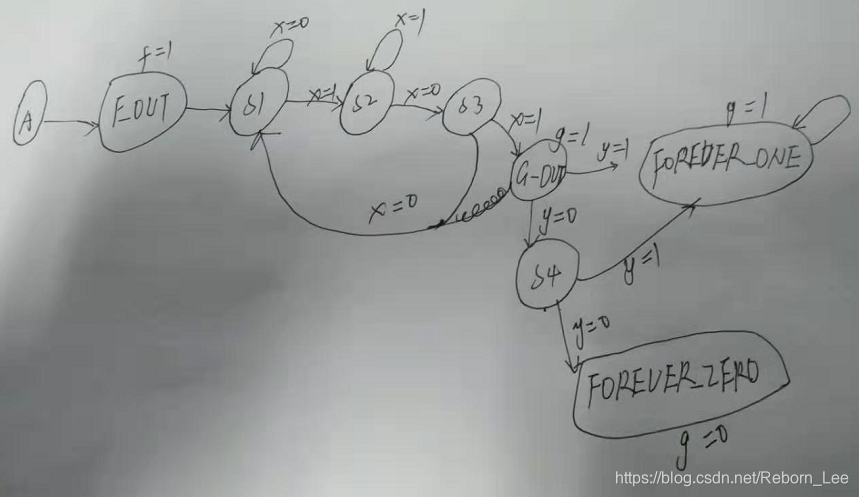
The FSM has to work as follows. As long as the reset input is asserted, the FSM stays in a beginning state, called state A. When the reset signal is de-asserted, then after the next clock edge the FSM has to set the output f to 1 for one clock cycle. Then, the FSM has to monitor the x input. When x has produced the values 1, 0, 1 in three successive clock cycles, then g should be set to 1 on the following clock cycle. While maintaining g = 1 the FSM has to monitor the y input. If y has the value 1 within at most two clock cycles, then the FSM should maintain g = 1 permanently (that is, until reset). But if y does not become 1 within two clock cycles, then the FSM should set g = 0 permanently (until reset).
(The original exam question asked for a state diagram only. But here, implement the FSM.)
Module Declaration

module top_module ( input clk, input resetn, // active-low synchronous reset input x, input y, output f, output g
);
- 1
- 2
- 3
- 4
- 5
- 6
- 7
- 8
- 9
- 10
题目解析
当时没有明白的还是这一句话:
While maintaining g = 1 the FSM has to monitor the y input. If y has the value 1 within at most two clock cycles, then the FSM should maintain g = 1 permanently (that is, until reset). But if y does not become 1 within two clock cycles, then the FSM should set g = 0 permanently (until reset).
更确切的是这句话:
While maintaining g = 1 the FSM has to monitor the y input. If y has the value 1 within at most two clock cycles, then the FSM should maintain g = 1 permanently (that is, until reset).
是接下来的两个时钟周期内,有一个y为1就可以了,之后的输出永久为1,如果没有一个为1,则永久为0.
根据题目,给出状态转移图:
状态转移图
设计文件
module top_module ( input clk, input resetn, // active-low synchronous reset input x, input y, output f, output g
); parameter A = 4'd0, S1 = 4'd1, S2 = 4'd2, S3 = 4'd3, S4 = 4'd4; parameter G_OUT= 4'd5, FOREVER_ONE = 4'd6, FOREVER_ZERO = 4'd7; parameter F_OUT = 4'd8; reg [3:0] current_state; reg [3:0] next_state; always@(posedge clk)begin if(resetn == 1'b0)begin current_state <= A; end else begin current_state <= next_state; end end always@(*)begin case(current_state) A:begin next_state = F_OUT; end F_OUT:begin next_state = S1; end S1:begin next_state = x ? S2 : S1; end S2:begin next_state = x ? S2 : S3; end S3:begin next_state = x ? G_OUT: S1; end G_OUT:begin next_state = y ? FOREVER_ONE : S4; end S4:begin next_state = y ? FOREVER_ONE : FOREVER_ZERO; end FOREVER_ONE:begin next_state = FOREVER_ONE; end FOREVER_ZERO:begin next_state = FOREVER_ZERO; end default:begin next_state = A; end endcase end assign f = (current_state == F_OUT); assign g = (current_state == S4 || current_state == G_OUT || current_state == FOREVER_ONE); endmodule
- 1
- 2
- 3
- 4
- 5
- 6
- 7
- 8
- 9
- 10
- 11
- 12
- 13
- 14
- 15
- 16
- 17
- 18
- 19
- 20
- 21
- 22
- 23
- 24
- 25
- 26
- 27
- 28
- 29
- 30
- 31
- 32
- 33
- 34
- 35
- 36
- 37
- 38
- 39
- 40
- 41
- 42
- 43
- 44
- 45
- 46
- 47
- 48
- 49
- 50
- 51
- 52
- 53
- 54
- 55
- 56
- 57
- 58
- 59
- 60
- 61
- 62
- 63
- 64
文章来源: reborn.blog.csdn.net,作者:李锐博恩,版权归原作者所有,如需转载,请联系作者。
原文链接:reborn.blog.csdn.net/article/details/103570177

- 点赞
- 收藏
- 关注作者
评论(0)